
Bitwarden review (2026): a generous free plan and code anyone can check
Bitwarden is the password manager to start with if you don't want to pay: the free plan stores unlimited passwords and syncs them to every phone, computer and browser you use. If you do pay, Premium costs $19.80 a year and adds the built-in authenticator, file attachments, vault health reports and emergency access. Businesses get per-seat pricing of $4 on Teams and $6 on Enterprise, but SSO, enforced policies and self-hosting are Enterprise only. Skip it if you want monthly billing for yourself, a VPN in the same subscription, or phone support.
What we like
- Free plan with unlimited passwords on unlimited devices, with no time limit
- Premium is $19.80 a year, and Families covers six people for $47.88
- Source code on GitHub, regular third-party audits, and SOC 2 Type II and ISO 27001 certifications
- You can host the server yourself with Docker on Linux or Windows
- Send shares encrypted text or files with people who don't use Bitwarden, and deletes them within 31 days
- Enterprise SSO, SCIM and directory sync work with Okta, Entra ID, Google Workspace, JumpCloud and others
What could be better
- Premium and Families bill yearly only
- Free sharing stops at one other person
- Teams leaves out SSO, policies and self-hosting, so many companies need Enterprise at $6 per user
- No phone or live chat support listed
- Vault health reports and the built-in authenticator need a paid plan
- No refund policy published on the pricing or billing pages
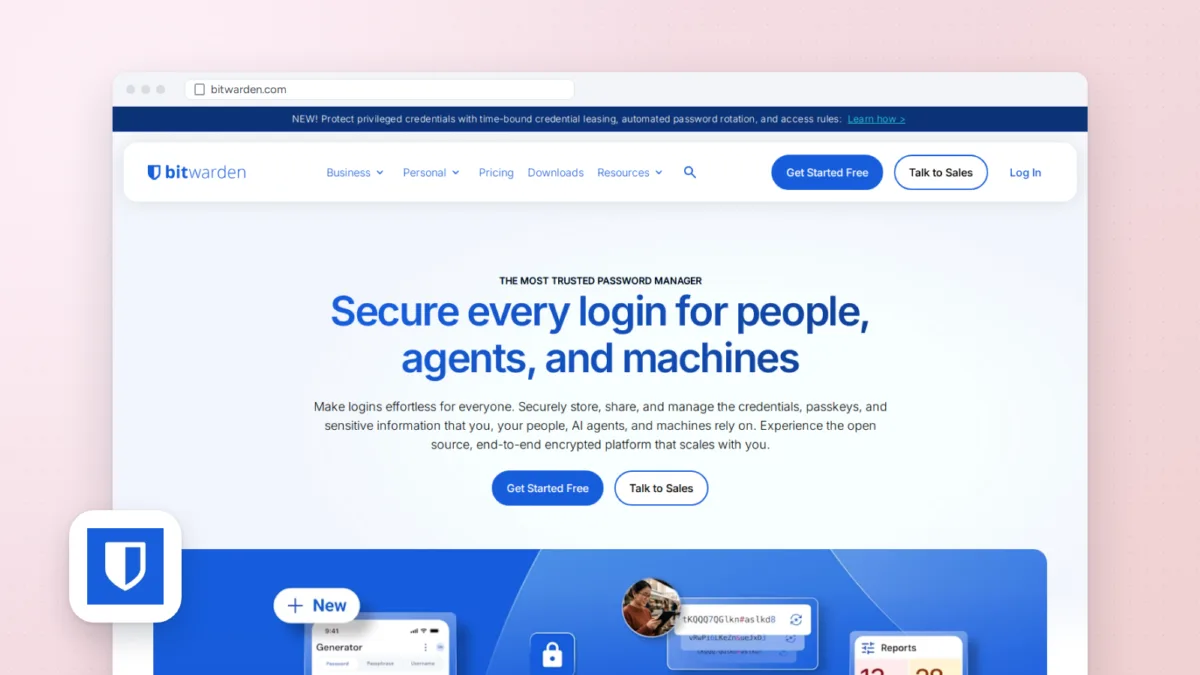
What Bitwarden is
Bitwarden is a password manager made by Bitwarden, Inc., based in Santa Barbara, California. Kyle Spearrin founded it in 2016 and is now its chief innovation officer; Michael Sullivan is chief executive. The company says it serves more than 15 million users and 80,000 businesses in over 180 countries.
The app keeps logins, secure notes, payment cards, identities and passkeys in an encrypted vault, fills them in on websites and apps, and syncs them across your devices. Its source code is on GitHub, where anyone can read it, audit it or suggest changes. For a lot of buyers that openness is the reason to choose it: you don't have to take the vendor's word for how your vault is protected.
Bitwarden has grown well beyond the basic vault since our 2021 review. It now sells Send for encrypted sharing links, a standalone Authenticator app, Secrets Manager for developers, and business tools such as SSO, SCIM provisioning and Access Intelligence. Prices have risen too. Our old listing had Families at $3.33 a month and Teams at $3 per user; on November 4, 2026 they were $3.99 and $4.
Setting up Bitwarden
You create an account with an email address and a master password. Choose that password with care, because Bitwarden can't reset or recover it. Your vault is encrypted with a key derived from the master password on your own device, using PBKDF2 with 600,000 rounds or Argon2id, so Bitwarden never holds anything that would let it in. Write the password down somewhere safe, and on Premium name an emergency contact (more on that below).
Next, install the apps you need. There are browser extensions for Chrome, Edge, Firefox, Safari, Opera, Brave, Vivaldi, DuckDuckGo and Tor; desktop apps for Windows, macOS and Linux; apps for iPhone and Android, plus an F-Droid build; a web vault; and a command-line tool for scripting. The link get.bitwarden.com sends each device to the right download.
To bring your passwords across, Bitwarden has import guides for LastPass, 1Password, Keeper, Dashlane, KeePass, Password Safe and the password stores in Chrome, Edge, Firefox and Safari. You can import from the web app, the browser extension, the desktop app or the command line, and the data is encrypted on your device before it uploads. Bitwarden notes that some item types can't be imported, so check the guide for your old manager before you delete anything there.
Finally, turn on two-step login. Even free accounts can use a hardware security key, an authenticator app or email codes. Premium adds Duo and Yubico OTP and lets you register up to 10 hardware keys.
A business sets up an organization instead, picks the number of seats and chooses yearly or monthly billing. New Families, Teams and Enterprise organizations get a 14-day free trial, and Bitwarden doesn't charge until it ends. Upgrading an existing organization from Teams to Enterprise doesn't start a new trial. The help center has a proof-of-concept checklist and a LastPass Enterprise migration guide for companies switching over.
The free plan in daily use
The free plan is where Bitwarden stands out. One person gets unlimited logins, notes, cards and identities, synced across unlimited devices, with autofill, the password generator and encrypted export. There is no time limit.
You can also share with one other person. Any user can own one free organization with two members and up to two collections, which covers a couple sharing the streaming and utility logins. Send works on the free plan for text only, up to 1,000 characters per link.
Compare that with LastPass Free, which works on desktop or on mobile but not both, and lets you share one password with one person at a time. With Bitwarden you can keep your phone and laptop in sync without paying anything.
The free plan leaves out encrypted file attachments, the built-in authenticator, vault health reports and emergency access. Bitwarden's billing help also says free accounts can be used for business purposes, provided you follow its terms of service, though a company that wants shared vaults and an audit trail needs Teams or Enterprise.
What Premium and Families add
Premium costs $19.80 a year, which Bitwarden shows as $1.65 a month. There is no monthly option for individuals. For that you get:
- An integrated authenticator that stores the six-digit codes for your other accounts and fills them in after the password
- 5 GB of encrypted file attachments, for a passport scan or a recovery code file, with more storage for a fee
- Vault health reports that flag weak, reused and exposed passwords, plus alerts that prompt you to update at-risk passwords as you use them
- Emergency access, where a trusted contact can request view-only or full takeover access to your vault; you approve it, or it opens after a wait time you set
- Send for files up to 500 MB (100 MB from mobile), as well as text
- Duo and Yubico OTP two-step login and priority support
Premium on its own doesn't include sharing beyond the free organization. For a household, Families is the better buy: $47.88 a year for six Premium accounts, which works out to $7.98 per person. It adds unlimited sharing and collections, and 5 GB of shared storage on top of each member's own 5 GB. Families has a 14-day free trial; Premium doesn't, though the free plan lets you test the core app first.
Bitwarden for businesses
Bitwarden splits business use into two published plans, both priced per user with no seat cap.
Teams costs $4 per user a month on yearly billing. Every member gets Premium features. Admins get unlimited shared collections, user groups, the public API, Directory Connector for syncing users from Microsoft Entra ID, Google Workspace, Okta, OpenLDAP and other directories, and SCIM provisioning from Entra ID, Okta, OneLogin, JumpCloud and Rippling. Event logs record more than 50 event types with timestamps, device type, IP address and user, keep them indefinitely and export them.
Enterprise costs $6 per user a month on yearly billing and adds login with SSO through providers including Okta, Microsoft Entra ID, Google, Duo, Auth0, JumpCloud, PingFederate, OneLogin and Keycloak. You also get enterprise policies, custom admin roles, account recovery for locked-out staff, self-hosting and a free Families plan for every employee to use at home. Access Intelligence, the newest Enterprise tool, looks for at-risk and unmanaged credentials, ranks your most important applications and guides staff to update weak passwords. Qualified customers get a dedicated success manager and onboarding help.
The gap between the two plans matters. A 20-person company that wants employees to sign in through Google or Okta, or wants to enforce organization-wide policies, has to buy Enterprise: $1,440 a year instead of $960. Bitwarden also lists a custom-quoted plan for large organizations, and its site advertises newer privileged-access tools, time-bound credential leasing and automated password rotation, which you should raise with sales.
Security teams can send event logs to Splunk, Microsoft Sentinel, Elastic, Rapid7, Sumo Logic, Datadog, Panther, Huntress, Blumira or any HTTP event collector. Bitwarden's integrations page lists more than 60 integrations in all.
Security and audits
Bitwarden encrypts each vault on your device with AES-256 in CBC mode, checked with HMAC SHA-256, before anything syncs to its servers. Your master password is stretched with PBKDF2 or Argon2id, and Bitwarden's servers only ever hold encrypted data.
On top of the open code, Bitwarden commissions third-party security audits and penetration tests of each client, including the web vault, browser extension and desktop app, and it runs a public bug bounty program. It holds SOC 2 Type II, SOC 3 and ISO 27001 certifications, says it is HIPAA compliant with annual third-party audits, and states compliance with GDPR and the California privacy laws. SOC 2 reports are available on request, which helps if your auditors ask for your vendors' reports.
Open source doesn't make software safe by itself. It means you or anyone you hire can check the work, and that researchers outside the company read the same code Bitwarden ships. Your own habits still matter most: a long master password and two-step login on the Bitwarden account itself.
Self-hosting and Secrets Manager
You can run Bitwarden on your own server. The help center has Docker-based install guides for Linux and Windows, including offline installs for networks without internet access, and every Bitwarden app can connect to a self-hosted server. Paid features follow your plan, and only Families and Enterprise organizations can move to a self-hosted server. For businesses that means Enterprise. When you host it, backups, updates and uptime are your job, and the help center has guides for each.
Secrets Manager is a separate product for developers who need to keep API keys and database passwords out of code and config files. A free plan covers two users, three projects and three machine accounts. Teams costs $6 per user a month with 20 machine accounts, and Enterprise $12 with 50, both with $1 for each extra machine account. It plugs into GitHub Actions, GitLab CI/CD, Ansible, Kubernetes, Terraform and Jenkins.
Pricing and value
Bitwarden is cheap at every level. Premium at $19.80 a year is less than half the regular price of 1Password Individual, which lists at $3.99 a month billed yearly. A family of six pays $47.88 a year. A business pays $4 or $6 per user a month on yearly billing, with Secrets Manager extra.
The catches are about billing and plan boundaries. Premium and Families bill yearly only. Teams and Enterprise can bill monthly, but Bitwarden doesn't publish the monthly rate. Prices exclude tax. And because SSO, policies and self-hosting sit on Enterprise, a security-minded small company often pays 50% more per seat than the Teams price suggests.
We found no refund policy on Bitwarden's pricing or billing pages, so check the terms before you buy a large number of seats. The 14-day organization trial is the safer way to test with your team.
Support
Bitwarden lists 24/7 email support for every user, with priority handling for paid plans. You reach it through a contact form for technical, billing and product questions. It doesn't list phone support or live chat.
The help center is detailed: it covers each app, every import source, self-hosting, SSO setup for each identity provider and the admin console, with downloadable PDFs of each page. There are also community forums and online courses. Enterprise customers who qualify get a dedicated success manager and help with onboarding and training.
Bitwarden compared with 1Password and LastPass
1Password has no free plan on its pricing page. Individual lists at $3.99 a month and Families at $5.99 a month for five people, both billed yearly; on November 4, 2026, new customers paid $2.99 and $4.49 for the first year. Both plans come with a 14-day free trial and no card required. Choose 1Password if you are happy to pay and want a trial before you commit. Choose Bitwarden if you want a capable free plan, the lower price once you pay, open code or the option to host it yourself. Bitwarden's Families plan also covers six people to 1Password's five.
LastPass keeps a free plan, but it works on one device type, desktop or mobile, and lets you share only one password with one person at a time. LastPass Free leaves out emergency access and hardware security keys, and its support is self-service only. It does include dark web monitoring. Paid LastPass plans come with trials of 30 days for Premium and Families and 14 days for business plans, and LastPass Teams is capped at 50 users. LastPass Premium costs $36 a year and Families $48 a year for six people, so Bitwarden is cheaper for one person and about the same for a family. For a free user who wants passwords on both phone and laptop, Bitwarden is the clear choice.
If you want email aliases built in, Proton Pass gives free users 10 hide-my-email aliases. If you want a VPN bundled with your passwords, Dashlane Premium includes one.
Pricing and value
Checked November 4, 2026, in US dollars, with monthly figures on yearly billing and tax extra:
- Free: $0. One user, unlimited items and devices, text Send, sharing with one other user.
- Premium: $1.65 a month, billed $19.80 a year. Authenticator, 5 GB attachments, health reports, emergency access, file Send.
- Families: $3.99 a month, billed $47.88 a year. Six Premium accounts, unlimited sharing. 14-day trial.
- Teams: $4 per user a month. Event logs, groups, API, directory sync, SCIM. 14-day trial.
- Enterprise: $6 per user a month. Adds SSO, policies, custom roles, account recovery, self-hosting, free Families for each user. 14-day trial.
- Secrets Manager: free for 2 users, or $6 (Teams) and $12 (Enterprise) per user a month.
Teams and Enterprise can bill monthly, at a rate Bitwarden doesn't publish.
Who should buy it
Buy Bitwarden, or start on its free plan, if you want your passwords on every device without paying, or if you want a cheap, capable Premium or Families plan for the extras. It suits privacy-minded users and IT teams who want open code they can inspect, and organizations that need to host the server themselves. Companies already on Okta, Entra ID, Google Workspace or JumpCloud will find SSO and SCIM support on Enterprise.
Who should skip it
Skip Bitwarden if you want to pay month to month for a personal or family plan, since both bill yearly. Skip it if you want a VPN in the same subscription, if you need to share with several people for free, or if your team expects phone or live chat support. A small company that needs SSO but balks at $6 per user should compare business quotes before deciding.
Questions people ask
Is Bitwarden free?
Yes. The free plan has no time limit and stores unlimited passwords, notes, cards and identities on unlimited devices. Paid plans add file attachments, the built-in authenticator, vault health reports and emergency access.
Is Bitwarden Premium worth $19.80 a year?
It is if you want the built-in authenticator, encrypted file storage or emergency access for a family member. If you only need passwords synced across devices, the free plan already does that. A household of two or more usually gets better value from Families at $47.88 a year for six people.
Is Bitwarden better than 1Password?
Bitwarden costs less, has a free plan, publishes its code and can be self-hosted. 1Password has no free plan, costs $3.99 a month for Individual at its regular price, and gives a 14-day trial with no card. Pick on budget and whether open code or self-hosting matters to you.
Can Bitwarden be hacked?
No password manager can promise that, but Bitwarden encrypts your vault on your device with AES-256 before it syncs, so its servers hold only encrypted data. It publishes its source code, commissions third-party audits and runs a bug bounty program. A strong master password and two-step login on your account are your best protection.
Does Bitwarden work on iPhone and Android?
Yes. Bitwarden has apps for iPhone and Android, plus an F-Droid build, and they autofill logins in apps and browsers. The free plan syncs your vault between your phone and your computers.
Does Bitwarden have a free trial for businesses?
Yes. New Teams and Enterprise organizations get a 14-day free trial, and Bitwarden doesn't charge until it ends. Upgrading an existing organization from Teams to Enterprise doesn't start a new trial.
Related reading



About the editorial team
Mutuo MbillaContributing writer
Wrote 127 articles and 113 product listings for Woofresh between 2016 and 2025.
Sources we checked 25
- bitwarden.com/pricing for personal and business prices, plan contents, trials, support checked November 4, 2026
- bitwarden.com/pricing/business for Teams and Enterprise features, Secrets Manager pricing, event logs, Access Intelligence checked November 4, 2026
- bitwarden.com/help/password-manager-plans for free plan and free organization limits, billing frequency, self-hosted organizations checked November 4, 2026
- bitwarden.com/help/about-organizations for 14-day trials, monthly billing for Teams and Enterprise, upgrade rule checked November 4, 2026
- bitwarden.com/help/secrets-manager-plans for Secrets Manager free plan limits checked November 4, 2026
- bitwarden.com/about for founding year, founder, chief executive, headquarters, user and business numbers checked November 4, 2026
- bitwarden.com/download for apps, browser extensions, F-Droid and command line checked November 4, 2026
- bitwarden.com/integrations for SSO, directory, SCIM, SIEM and CI/CD integrations, integrations count checked November 4, 2026
- bitwarden.com/compliance for certifications, audits and penetration tests checked November 4, 2026
- bitwarden.com/help/what-encryption-is-used for AES-CBC 256 and HMAC SHA-256 checked November 4, 2026
- bitwarden.com/help/bitwarden-security-white-paper for PBKDF2 600,000 rounds and Argon2id checked November 4, 2026
- bitwarden.com/help/about-send for Send size and lifespan limits checked November 4, 2026
- bitwarden.com/help/emergency-access for emergency access view and takeover checked November 4, 2026
- bitwarden.com/help/storing-passkeys for passkey storage checked November 4, 2026
- bitwarden.com/help/import-data for import sources and local encryption on import checked November 4, 2026
- bitwarden.com/help/install-on-premise-linux for self-hosting deployment options checked November 4, 2026
- bitwarden.com/help/billing-faqs for business use of free accounts checked November 4, 2026
- bitwarden.com/products/personal for master password recovery, Families trial checked November 4, 2026
- bitwarden.com/open-source for source code on GitHub checked November 4, 2026
- bitwarden.com/contact for support contact form checked November 4, 2026
- 1password.com/pricing/password-manager for 1Password prices, promotion and trial checked November 4, 2026
- lastpass.com/pricing for LastPass free plan limits, trials and Teams user cap checked November 4, 2026
- proton.me/pass/pricing for Proton Pass free aliases checked November 4, 2026
- dashlane.com/pricing-personal for Dashlane Premium VPN checked November 4, 2026
- lastpass.com/lpapi/purchase/productcatalog for LastPass comparison: Premium $36 a year and Families $48 a year in US dollars (the price catalog LastPass's pricing page loads) checked November 4, 2026