
LastPass review (2026): pricing, the 2022 breach and who it suits
LastPass is a capable password manager with good sharing, emergency access and business controls, and Premium costs $3 a month and Families $4 a month for six people, both billed yearly. Its free plan works on computers or on phones but not both, which makes it weaker than Bitwarden's free plan. In 2022 an attacker stole backups of every customer's vault, and LastPass has since rebuilt its systems and raised its encryption settings. Families and small businesses who are comfortable with that history will find it good value; anyone who is not should look at Bitwarden or 1Password.
What we like
- Families covers six people with private vaults and shared folders for $48 a year
- The free plan includes unlimited passwords, autofill, the security dashboard and dark web monitoring
- Extensions for Chrome, Firefox, Edge, Safari and Opera, plus apps for iOS, Android and Apple Watch
- Passkeys sync across browsers and operating systems
- Emergency access with a waiting period you set
- Business includes directory sync with six identity providers, SIEM feeds, SSO for three apps and a free Families account for every employee
- 30-day personal and 14-day business trials with no card
What could be better
- In 2022 an attacker stole backups of all customer vaults, and website URLs in them were unencrypted
- The free plan works on one device type only, computers or mobile
- Every plan is billed yearly, with no monthly option
- The VPN in Plus runs on Windows only
- Free users get no personal support
- Teams stops at 50 users and has no groups or directory sync
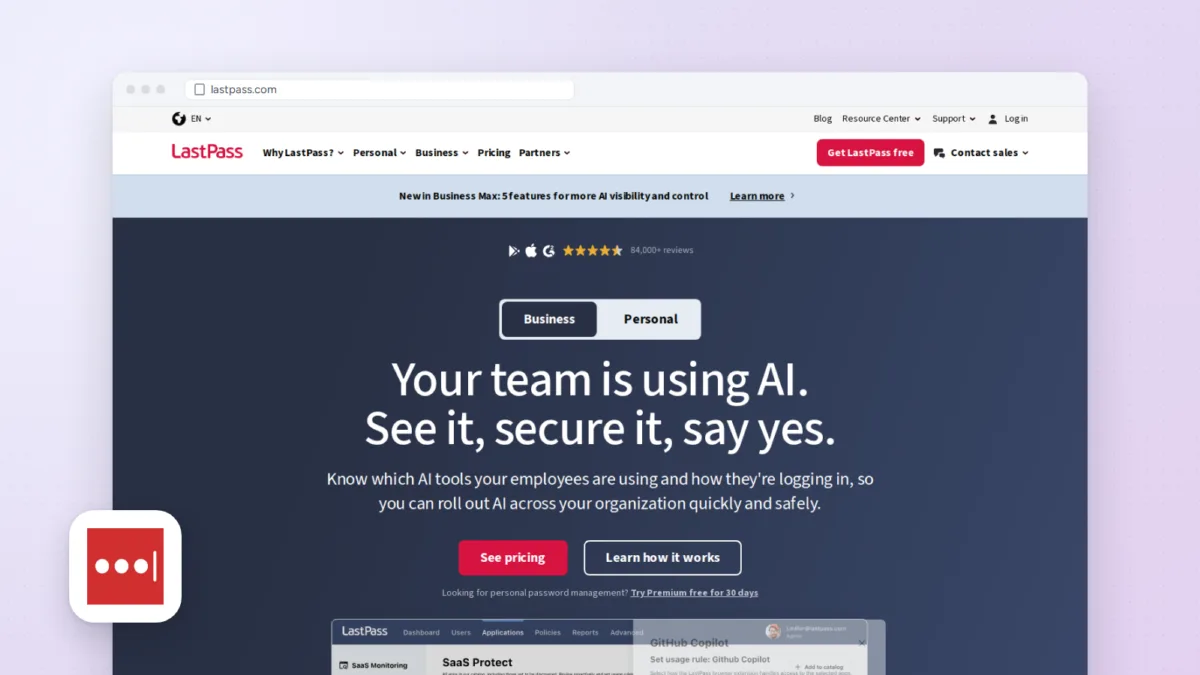
What LastPass is in 2026
LastPass is a password manager that has been sold since 2008. You install a browser extension or an app, save your logins to an encrypted vault, and LastPass fills them in the next time you visit a site. The same vault holds passkeys, secure notes, payment cards and addresses, and it syncs between your computer and your phone.
The company has changed hands twice. LogMeIn, now called GoTo, bought it in 2015, and in 2024 LastPass separated from GoTo and became a standalone company again, based in Boston. It says more than 100,000 businesses use it. Its business plans now reach beyond the vault: the top tier, Business Max, watches which SaaS and AI tools employees sign in to and lets admins block the risky ones.
Two questions decide whether LastPass suits you in 2026. The first is trust, because of the breach LastPass disclosed in December 2022. The second is the free plan, which works on only one type of device. The rest of the product is mature, covers every major browser and phone, and costs about what its rivals charge.
The 2022 breach and what LastPass changed
LastPass's own summary, published on March 1, 2023, describes two linked incidents. In the first, an attacker compromised a software engineer's laptop and took source code and internal secrets from a development environment. In the second, the attacker used what they had learned to target a senior DevOps engineer through vulnerable third-party software, and reached LastPass's cloud backups.
Those backups held copies of all customer vault data. LastPass says the vault contents were encrypted under its zero-knowledge model and that master passwords were not taken, because it never stores them. Website URLs and a few other fields were not encrypted, though, and the attacker also took customer metadata and an encrypted MFA database together with the key that decrypts it.
In practice this means whoever holds those backups can try to guess master passwords offline, with no limit on attempts. A long, unique master password still protects the old copy of a vault; a short or reused one may not. The unencrypted URLs also show which sites each customer had accounts with. Changing your master password today does not change the stolen copy, so if you had a LastPass account in 2022, change the passwords for important accounts that were in your vault at the time.
LastPass says it rebuilt much of its infrastructure while it separated from GoTo. Its security page lists a higher PBKDF2 setting of 600,000 iterations, new monitoring and endpoint protection, a new software build process, and certifications including SOC 2 Type II, ISO 27001 and BSI C5. Those are sensible steps, and they make the service safer to use now. Some buyers, especially IT teams that have to defend the choice to clients or auditors, will still rule LastPass out on this history, and we think that is a fair position to take.
Setting up LastPass
You sign up with an email address and a master password, and a new account starts with a 30-day trial of Premium with no card required. Then you add the extension for Chrome, Firefox, Edge, Safari or Opera, and the apps for iPhone, iPad, Android and Apple Watch. On Windows and Mac you can also install the LastPass desktop app, or a universal installer that adds the extension to every browser at once. On Linux you use the browser extensions.
To bring your passwords across, open the vault, choose Advanced Options, then Import, and pick the browser you are leaving. The newer Mobile Smart Scanner reads typed or handwritten passwords with your phone camera, which helps if your old system was a notebook in a drawer.
Take care over the master password. LastPass does not store it, and after 2022 its length matters more than ever, so use a long passphrase you have never used anywhere else. Then turn on multifactor authentication; the free LastPass Authenticator app works on every plan.
Saving, filling and passkeys
Day to day, LastPass behaves the way you would expect. When you sign in to a site, the extension offers to save the login, and on your next visit it fills in the username and password. It also fills forms with saved addresses and payment cards. The password generator creates a random password when you sign up somewhere, and a username generator makes throwaway usernames for sites that do not need your real name.
Passkeys sit in the same vault. You create and save them through the extension or the mobile app, and LastPass syncs them across browsers and operating systems. That matters if you use an iPhone with a Windows laptop and do not want your passkeys tied to Apple's or Google's own password tools.
Secure notes hold Wi-Fi codes, passport numbers and insurance details, and you can attach files to them: 50 MB in total on Free and 1 GB on paid plans. Offline mode keeps the vault readable without an internet connection, and travel mode lets you pick trusted countries where LastPass stays active.
Sharing, families and emergency access
Sharing is where the plans differ most. On Free you can share an item with one person at a time. Premium adds one-to-many sharing, so you can send the streaming login to everyone in the house in one go. Families gives up to six people their own Premium vaults, shared folders and a manager dashboard. Each member's vault stays private, and LastPass says not even the family manager can open it. You can revoke any share from the vault's sharing center.
Emergency access is on every paid plan. You invite a trusted LastPass user and set a waiting period. If they request access and you do not deny it within that period, they can open your vault and see your passwords and notes. It is an easy way to make sure a partner or grown-up child can reach your accounts if you are in the hospital, and LastPass also has a digital will feature for the same situation.
Security dashboard, breach alerts and MFA
The security dashboard gives your vault a score and lists weak, reused and old passwords with a suggestion for each. Dark web monitoring checks your saved email addresses against breach data from Enzoic, LastPass's monitoring partner, which only ever receives hashed addresses. You get an alert when one turns up. Both features are on the free plan, which is generous.
To protect the vault itself you can use SMS codes, one-time codes from any major authenticator app, or push approvals in LastPass Authenticator. On paid plans the Authenticator also runs on watchOS and Wear OS, and you can sign in without typing the master password using Face ID, a fingerprint or a FIDO2 key. Free users can go passwordless only through the Authenticator app. Families and all three business plans accept hardware keys such as YubiKey, and the business plans can also generate time-based one-time codes for other accounts from inside the vault.
The free plan's one-device-type limit
LastPass Free is still a usable password manager, with unlimited passwords, autofill, the generator, the security dashboard and dark web monitoring, and no time limit. The catch, in place since March 2021, is device types. LastPass counts two: computers, meaning every browser on desktops and laptops, and mobile, meaning phones, tablets and watches. Free works on as many devices as you like of one type only. Choose computers and you cannot open your vault on your phone, which is where many people need their passwords most.
Free accounts also get no emergency access and no personal support, share an item with only one person at a time, and have 50 MB of file storage. If you want a free plan for a laptop and a phone, Bitwarden Free has no device limit. If you are happy to pay $36 a year, LastPass Premium removes the restriction.
LastPass for teams and businesses
Teams costs $4.25 per user a month, billed yearly, and covers up to 50 users. You get the Admin Console, shared folders with permissions, 25 security policies such as minimum password strength, and basic reporting. It has no groups, directory sync or SIEM feeds, so it suits a small office where one person adds and removes staff by hand.
Business, at $7 per user a month, has no user cap and is the plan most companies will want. It raises the policy count to more than 100 and adds groups, finer user management and advanced reporting with feeds to Splunk and Microsoft Sentinel. Directory integrations with Microsoft Active Directory, Microsoft Entra ID, Google Workspace, Okta, OneLogin and PingOne or PingFederate create accounts for new hires and remove them for leavers. Federated login lets staff open their vault with their existing company sign-in.
Business also includes single sign-on for three apps from a catalog of more than 1,200, and every employee gets a free LastPass Families account with five extra licenses for family and friends. LastPass pitches that as a way to stop a compromised personal account from becoming a work problem. Managed service providers have a separate multi-tenant MSP program with a 30-day trial; LastPass does not publish its prices.
Business Max: SaaS, AI and web monitoring
Business Max costs $11 per user a month and adds what LastPass calls Secure Access Essentials, which its About page describes as the direction the company is heading. SaaS Monitoring & Protect finds the apps employees sign in to, including ones IT never approved, and lets admins allow, warn about or block them. AI Monitoring & Protect does the same for AI tools and can warn employees in real time when they try to share credentials, API keys or personal information with one. Web Monitoring & Protect blocks phishing and malware sites and whole website categories such as gambling.
The plan also removes the three-app SSO limit and adds MFA for SSO and cloud apps, contextual policies based on location, IP address and device, workstation MFA for Windows and Mac, and the Universal Proxy, which adds MFA to older apps and VPNs that use LDAP or RADIUS. For a small company without a separate SaaS management tool, that is a useful bundle at $4 per user more than Business. A larger firm that already runs Okta and a dedicated SaaS security product will find much of it duplicated.
LastPass Plus and the VPN
Plus is a newer personal plan at $7 a month, billed yearly at $84. It is Premium with LastPass VPN added: unlimited use on up to 10 devices, with 800+ servers in 125+ countries according to LastPass. The VPN is a separate app that signs in with your LastPass account. When we checked, it ran on Windows only, and LastPass says versions for macOS, iOS and Android are coming. Plus also lacks the shared folders and hardware key support that Families has. Unless every device you want to protect runs Windows, Premium and a separate VPN will cover more of them.
Pricing and value
At $36 a year, Premium sits in the middle of the market. Bitwarden Premium is $19.80 a year, and 1Password Individual lists at $3.99 a month billed yearly, with a promotional $2.99 when we checked. Families at $48 a year for six people is good value next to 1Password Families at $5.99 a month for five, and it matches Bitwarden Families at $47.88 for six.
For businesses, Teams at $4.25 per user is slightly more than Bitwarden Teams at $4, and Business at $7 is a dollar more than Bitwarden Enterprise at $6. The free Families account for every employee and the bundled SSO apps help close that gap.
Every LastPass plan is billed yearly, and the pricing page offers no monthly option. The trials are long enough to make a real decision: 30 days for personal plans and 14 days for business plans, with no card. If you stay on Free after a trial, your saved data remains in the vault and you lose the paid features.
Support
Every plan gets the self-service Support Center, which LastPass says is open around the clock, and a community forum that LastPass staff monitor. Paid plans add personal support from the customer care team, which the Premium comparison describes as email support. Free users get no personal support. On Business and Business Max, a customer success manager is available depending on the account, and sales answers by chat. LastPass also runs a public status page and an email address for security reports. We did not test response times, and the help center would not load for us when we checked.
LastPass vs Bitwarden
Bitwarden is the obvious alternative if price or the free plan matters most. Its free plan has unlimited devices and unlimited passwords and lets you share with one other user, which already beats LastPass Free for anyone with a phone and a laptop. Premium costs $19.80 a year, Families $47.88 a year for six, and its business plans are $4 and $6 per user a month. Bitwarden's code is open source, and you can host the server on your own network.
LastPass is the easier pick if you want a business plan that includes free family accounts for staff, SSO for a few apps and, on Business Max, SaaS and AI monitoring in the same console. For a person or a family choosing today, Bitwarden costs less, has the better free plan and does not carry the 2022 history.
LastPass vs 1Password
1Password has no free plan. It offers a 14-day trial, and Individual lists at $3.99 a month billed yearly, with Families at $5.99 a month for five people, both cheaper under a first-year promotion when we checked. That makes it a little more expensive than LastPass for one person and noticeably more for a family.
The case for paying more rests on trust. If the 2022 breach rules LastPass out for you, 1Password is the paid alternative to try first. If it does not, LastPass Families at $48 a year gives one more person a vault for less money.
Pricing and value
Prices checked November 4, 2026, in US dollars, from LastPass's pricing page and the price catalog it loads. Every plan is billed yearly, and taxes are added at checkout.
| Plan | Price | Billed yearly | Who it is for |
|---|---|---|---|
| Free | $0 | $0 | 1 user on one device type |
| Premium | $3 a month | $36 | 1 user on all devices |
| Families | $4 a month | $48 | Up to 6 people |
| Plus | $7 a month | $84 | Premium plus a Windows-only VPN |
| Teams | $4.25 per user a month | $51 per user | Up to 50 users |
| Business | $7 per user a month | $84 per user | Any number of users |
| Business Max | $11 per user a month | $132 per user | Business plus SaaS, AI and web monitoring |
Personal plans have a 30-day trial and business plans 14 days, with no card required. The MSP program has a 30-day trial and unpublished prices.
Who should buy it
- Families who want six private vaults, shared folders and emergency access for $48 a year
- Small and midsize companies that want staff accounts managed through Entra ID, Active Directory, Google Workspace, Okta, OneLogin or PingOne
- Employers who like the idea of giving every employee a free Families account for home use
- Small companies that want SaaS and AI tool monitoring in the same console as their password manager (Business Max)
- Current LastPass users with long, unique master passwords who are happy with the service and have changed the passwords that were in their vault in 2022
Who should skip it
- Anyone who wants a free plan for both a laptop and a phone; Bitwarden Free has no device limit
- Buyers, or IT teams answering to clients and auditors, for whom the 2022 breach is disqualifying; try 1Password
- People who want to pay month to month
- Mac and phone users who want a VPN in the same subscription; Dashlane Premium includes one
- One person on a tight budget, since Bitwarden Premium costs $19.80 a year
Questions people ask
Is LastPass safe to use now?
LastPass encrypts your vault on your own device with AES-256, and since the 2022 breach it has raised its PBKDF2 setting to 600,000 iterations and rebuilt much of its infrastructure. The breach still matters: attackers hold old encrypted copies of customer vaults, with website URLs readable. With a long, unique master password and multifactor login, LastPass is reasonable to use; if you had an account in 2022, change the passwords that were in your vault then.
Does LastPass still have a free plan?
Yes. LastPass Free has no time limit and includes unlimited passwords, autofill and dark web monitoring. It works on one device type only, either computers or mobile devices, and it has no emergency access or personal support.
How much is LastPass Families?
Families costs $4 a month, billed yearly at $48, and covers up to six people. Each person gets a private Premium vault, and the plan adds shared folders and a family manager dashboard. It has a 30-day free trial. Price checked November 4, 2026.
Can I pay for LastPass monthly?
Not on the pricing page, which offers yearly billing only for every plan. The monthly figures LastPass shows are the yearly price divided by 12.
Does LastPass work with passkeys?
Yes. You can create, store and use passkeys through the LastPass extension and mobile apps, and they sync across browsers and operating systems along with your passwords.
Related reading



About the editorial team
Mutuo MbillaContributing writer
Wrote 127 articles and 113 product listings for Woofresh between 2016 and 2025.
Sources we checked 18
- lastpass.com/pricing for plans, what each plan includes, user limits, trial lengths, free plan limits, yearly billing, taxes at checkout, payment methods, support by plan checked November 4, 2026
- lastpass.com/lpapi/purchase/productcatalog for US dollar yearly prices for Premium ($36), Families ($48), Plus ($84), Teams ($51 per user), Business ($84 per user) and Business Max ($132 per user), and trial lengths; this is the price catalog the pricing page loads checked November 4, 2026
- lastpass.com/pricing/lastpass-premium-vs-free for Free versus Premium: one device type, one-to-one sharing, 50 MB versus 1 GB file storage, emergency access, watch app, passwordless options, personal email support checked November 4, 2026
- lastpass.com/company/about-us for founded 2008, Boston headquarters, LogMeIn purchase in 2015, separation from GoTo in 2024, 100,000+ businesses checked November 4, 2026
- lastpass.com/solutions/integrations for directory integrations, 1,200+ pre-integrated SSO apps, LDAP/RADIUS MFA, Business at $7 per user a month checked November 4, 2026
- lastpass.com/security/is-lastpass-secure for changes since the breach: PBKDF2 at 600,000 iterations, certifications, rebuilt infrastructure checked November 4, 2026
- blog.lastpass.com/posts/security-incident-update-recommended-actions for what was taken in the 2022 incidents and what was not encrypted checked November 4, 2026
- lastpass.com/features for feature list including username generator, digital will, monitoring products checked November 4, 2026
- lastpass.com/features/vpn for LastPass VPN: Windows only, 10 devices, 800+ servers, 125+ countries checked November 4, 2026
- lastpass.com/features/emergency-access for how emergency access and the waiting period work checked November 4, 2026
- lastpass.com/features/passkeys for passkey storage and sync, supported browsers and apps checked November 4, 2026
- lastpass.com/misc_download2.php for browser extensions, desktop app, universal installers, Linux options, mobile apps checked November 4, 2026
- lastpass.com/why-lastpass for importing from browsers, Enzoic breach monitoring with hashed email addresses checked November 4, 2026
- lastpass.com/contact-us for sales chat, support, responsible disclosure contact checked November 4, 2026
- lastpass.com/partner/managed-service-provider for MSP multi-tenant program and 30-day trial checked November 4, 2026
- bitwarden.com/pricing for Bitwarden free plan (unlimited devices), Premium $19.80 a year, Families $47.88 a year for 6, Teams $4 and Enterprise $6 per user a month, open source and self-hosting checked November 4, 2026
- 1password.com/pricing/password-manager for 1Password Individual $3.99 and Families $5.99 a month billed yearly (promotional $2.99 and $4.49), 14-day trial, no free plan checked November 4, 2026
- dashlane.com/pricing-personal for Dashlane Premium includes a VPN; Friends & Family covers 10 members; 14-day Premium trial checked November 4, 2026