
Klaviyo review (2026): email and texts built on your store data
Klaviyo is the right buy for an online store, especially on Shopify or WooCommerce, that wants emails and texts triggered by what shoppers browse, add to cart and buy. Its flows, all-time segments and predicted lifetime value go further than cheaper tools, and the free plan covers 250 active profiles and 500 emails a month. You pay per active profile, from $20 a month for 500 to $150 for 10,000, with texts, reviews and helpdesk billed on top. Skip it if you run a newsletter with little order data, need human support on a free account, or want the lowest price per contact.
What we like
- More than 60 ready-made flows, including abandoned cart, browse abandonment, price drop and back in stock
- Segments use a profile's full event history with no look-back limit or extra charge
- Predicted lifetime value, churn risk and next order date are built into segments and flows
- Email, text, WhatsApp and push in the same flow, with unlimited push sends on every plan
- Free plan includes flows, segments, forms and reports, not only campaigns
- Reviews, Helpdesk and Customer Agent share the same customer profile as your marketing
What could be better
- Cost rises steeply with list size: $375 a month at 20,000 profiles for email alone
- Texts need a separate credit plan, starting at $15 a month for 1,250 credits
- Free accounts lose email support 60 days after sign-up and never get human chat
- No free trial on paid Email plans and no published yearly discount
- Advanced attribution, funnels and cohorts sit behind the $100-a-month Personalization add-on
- Much of its depth goes unused by stores with little order history
What Klaviyo is in 2026
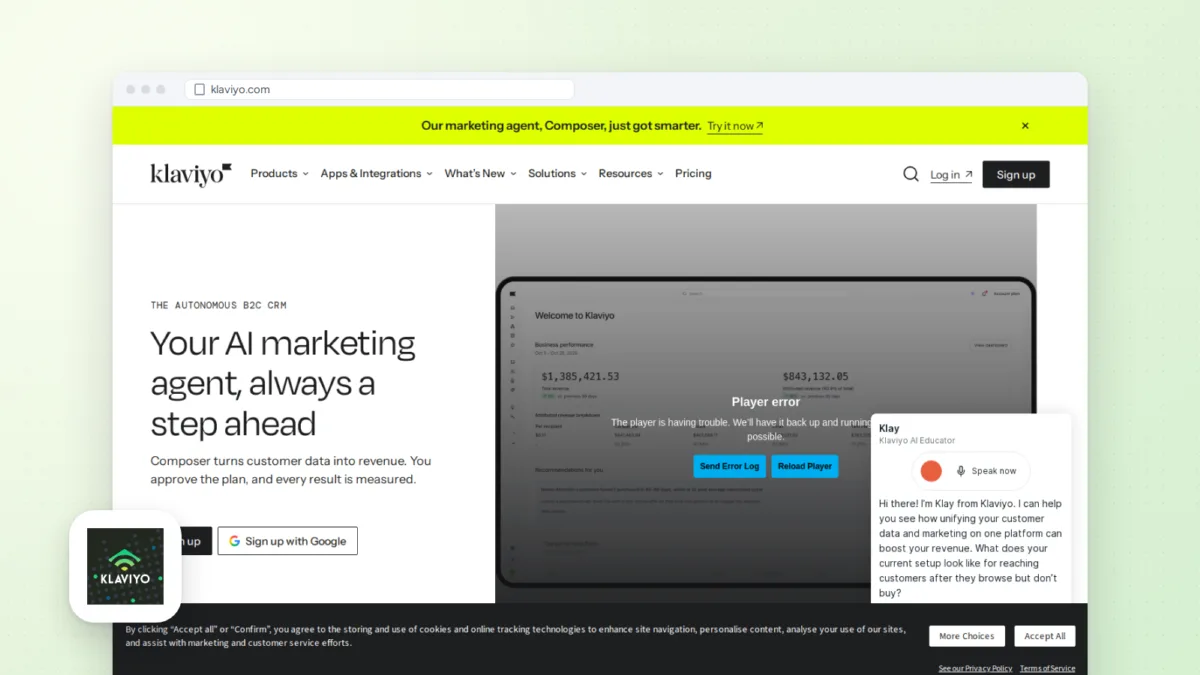
Klaviyo started in Boston in 2012 as a customer database, added email in 2013 and SMS in 2021, and now sells itself as a CRM for consumer brands. In practice it is still an email and text marketing tool for online stores, with a few newer products around it: product reviews, a helpdesk, an on-site Customer Hub and two AI agents called Composer and Customer Agent. Klaviyo says more than 205,000 paying brands in over 100 countries use it.
Everything runs from one profile per shopper. When a store is connected, each profile collects that person's orders, product views, cart activity, form sign-ups and message engagement, and keeps it for as long as the data exists. Every flow, segment, form and report reads from those profiles, which is why Klaviyo works best for stores with real order data and less well for a newsletter with nothing to sell.
Klaviyo is a web app, and the platform and Help Center are available in 12 languages, including English, Spanish, French, German and Japanese.
Setting up Klaviyo
You can open a free account without paying and stay on it for as long as your list fits: up to 250 active profiles and 500 emails a month. The free plan lets you import or sync contacts and their activity, use the drag-and-drop email and text editors, and build flows, segments and reports, so you can set up most of an account before spending anything.
The first real step is connecting your store. Klaviyo's pricing FAQ names Shopify, WooCommerce and Wix as stores the free plan suits, and the homepage counts more than 400 integrations in all, from payment and review apps to ad platforms. Once the store is connected, orders and browsing events start filling profiles, and the predictive fields such as expected next order date have something to work from.
After that, most stores do three things: publish a sign-up form from one of the 70-plus templates, switch on the welcome, abandoned cart and browse abandonment flows from Klaviyo's templates, and edit the emails to match the brand. None of this needs a developer. Mobile push is the exception, because it needs your own shopping app with Klaviyo connected to it.
When you outgrow the free plan you upgrade under Account Settings, then Billing. Paid plans bill monthly from the day you first pay.
Flows and automations
Flows are Klaviyo's automations, and they are where it earns its price. You can start from more than 60 ready-made flows or type a description and let Klaviyo AI draft one. The templates cover the flows an online store usually needs first: welcome series, abandoned cart, browse abandonment, post-purchase follow-up, price drop and back in stock.
Triggers come from what shoppers do: viewing a product, starting checkout, placing an order, filling in a form, a price drop, a birthday or anniversary, a predicted next order date, or going quiet for a while. Inside a flow you can split people by cart value, VIP status, new or returning customer, location, recent site visits, product type or lifetime value. That means one abandoned cart flow can send a big-spending repeat customer a different message from a first-time visitor with a $15 cart.
A single flow can mix email, text and push steps, so you might send an email first and a text a day later only to people who haven't opened it. Webhooks let a flow call another app, for example to award loyalty points or send a thank-you card. You see each flow's results inside the builder, and you can A/B test send times, channels, content and discount offers.
Segments and predictions
Klaviyo stores event data on each profile without a time limit, so a segment can look back as far as your data goes at no extra charge. You could build a list of UK customers who bought from one product category with a discount code last holiday season, and the segment keeps itself current as people join or drop out.
On top of the raw data, Klaviyo adds predicted fields such as customer lifetime value, churn risk and expected next order date, plus RFM groupings (recency, frequency and money spent). If you would rather not build conditions by hand, Segments AI takes a plain description, such as customers who opened a support ticket and placed an order in the last 30 days, and builds the segment for you. Segments can also sync to ad platforms to build lookalike audiences or leave recent buyers out of retargeting.
This is the clearest difference between Klaviyo and cheaper newsletter tools. The more order history you have, the more these segments are worth, and a store with a few hundred customers will use only a small part of it.
Sign-up forms
Klaviyo's form builder covers pop-ups, fly-outs, embedded forms, full-page forms, banners and teasers, with more than 70 templates sorted by type and goal. You can add dropdowns, countdowns, checkboxes and multi-step forms that ask for an email address first and a phone number second, and a spin-to-win wheel if your brand suits it.
Targeting is detailed: show or hide a form by segment, location, cart value or UTM tag, or on exit, after a set scroll depth or time on page. For Shopify stores, Klaviyo can prefill fields for Shop Pay users, and its SMS opt-in sends a one-time code that fills itself in on iPhone and Android. Forms report the revenue they lead to as well as sign-ups, and you can A/B test designs, copy and offers. Most stores won't need a separate pop-up tool.
Emails, texts and push
The email editor is drag-and-drop with a template library, and even the free plan includes an AI subject line generator. Product blocks and personalization draw on the same profile data, so an email can show items related to what someone browsed or bought.
Texts work differently from email in billing. SMS, MMS, WhatsApp and RCS messages are paid through a separate mobile messaging plan of prepaid credits, starting at $15 a month for 1,250 credits. In the US a text costs 1 credit and a picture message costs 3, and rates change by country, so a store texting abroad should check the calculator before planning a campaign. Mobile push is different again: if you have your own shopping app, push sends are unlimited on every Klaviyo plan.
Reviews, helpdesk and the AI agents
Klaviyo now sells several products that sit next to email. Reviews, available for Shopify and WooCommerce stores, asks for product and video reviews by email, text, push or WhatsApp, shows them on your site and syncs them to Google Shopping, the Shop app and Meta stores. Because review answers land on the profile, a 5-star review can trigger a thank-you discount and a 3-star review can open a support ticket. It is free up to 50 orders a month and $25 for 250.
Helpdesk puts each customer's orders and marketing history inside the support ticket, uses AI to tag and route tickets, and can trigger a flow or pause a campaign when a ticket closes. It has a 30-day free trial and starts at $10 a month for 50 tickets. Customer Agent is an AI assistant that answers common questions and recommends products, then passes harder conversations to a person. Klaviyo says it resolves 65% of questions without a person, and the first 50 resolutions are free.
Composer is the newer marketing agent. You can ask it questions about your account, have it audit flows and forms, build segments and campaigns from a prompt, or schedule recurring reports. Klaviyo says you review customer-facing work before it goes live. Free accounts get $5 of Composer use a month and paid use starts at $20 a month.
You don't need any of these to get value from Klaviyo, but if you already pay for a separate helpdesk or reviews app, it is worth pricing what moving them would cost.
Reports and attribution
Every plan, free included, has built-in dashboards for campaign performance, opens and clicks, list growth and revenue attributed to each campaign. For many stores that is enough to see which emails paid for themselves.
The Personalization add-on, $100 a month on smaller lists, adds linear multi-touch attribution across channels, funnel and cohort reports, adjustable RFM analysis, custom prediction windows for lifetime value and AI-picked targeting and send times. It suits a store that already sends a lot and wants to know which channel deserves the credit for a sale. A small store can skip it.
Pricing and value
You pay by active profiles: contacts with an email address you can market to. Unsubscribed and suppressed contacts don't count, and neither do profiles with only a phone number. Each tier also has a monthly email limit, about ten times the profile count at most sizes. These are the monthly Email prices on Klaviyo's US calculator on November 4, 2026:
- 251 to 500 profiles: $20 a month, 5,000 emails
- 501 to 1,000 profiles: $30 a month, 10,000 emails
- 1,501 to 2,500 profiles: $60 a month, 25,000 emails
- 6,501 to 10,000 profiles: $150 a month, 100,000 emails
- 15,001 to 20,000 profiles: $375 a month, 200,000 emails
- 45,001 to 50,000 profiles: $720 a month, 500,000 emails
Texts, Reviews, Helpdesk, Personalization and Composer are added on top. A store with 2,500 profiles that wants a basic text plan pays $60 plus $15, so $75 a month, before any reviews or support tools.
If your list grows past its tier, Klaviyo doesn't stop sending; it moves you to the right tier at the next billing date. To stay on your current tier you need to remove or suppress profiles at least 24 hours before that date. Flexible overages let you send past your email limit for one cycle, or you can tell Klaviyo to stop sending instead. Free accounts that go over can't send email until they are back under the limit.
Klaviyo bills monthly and publishes no yearly discount for self-serve plans. There is no trial on paid Email plans. Until November 30, 2026, accounts that haven't paid Klaviyo in the past 12 months get $19 off the first month of the $20 plan.
For value, Klaviyo is fair at small sizes and expensive at large ones. $30 a month for 1,000 profiles with full flows and all-time segments is reasonable. At 20,000 profiles, $375 a month for email alone is a real cost, and it only pays off if those flows bring in clearly more than a cheaper tool would. Cleaning out unengaged profiles each month makes a noticeable difference to the bill.
Support
Support depends on whether you pay. Paid accounts get email support around the clock and live chat 24 hours a day on weekdays, with weekend chat hours that vary by plan. Free accounts get email support for 60 days after sign-up and no human chat; after that they rely on the Help Center, Klaviyo Academy courses, the Community and the virtual assistant.
Stores that want faster answers can buy a support package. Professional starts at $500 a month and adds faster replies, weekend chat and a training session a year. Enterprise starts at $1,800 a month with replies in 1 to 12 hours, 24/7 chat, two training sessions a year and its own technical architect and deliverability team. For most small stores the standard paid support is enough, but a free account running real campaigns after day 60 has little help available.
Klaviyo vs Omnisend
Omnisend is the closest rival for small and mid-sized stores, and it is cheaper to start. Its Standard plan lists at $16 a month for 500 contacts with 6,000 emails, against Klaviyo's $20 for 500 profiles and 5,000 emails. Texts come in on Omnisend's Pro plan, $59 a month at 2,500 contacts, and are paid per message, from $0.007 each for high-volume US sends. On Klaviyo the same list costs $60 for email plus a text credit plan from $15. On November 4, 2026, Omnisend was also taking 30% off when you pay three months upfront.
Omnisend's support is the other big difference: 24/7 live chat and email on every plan, free included, and a free migration of your contacts, data and segments. Klaviyo gives free accounts 60 days of email support and nothing human after that.
Klaviyo is the stronger choice when your data is the reason you're buying: segments with no look-back limit, predicted lifetime value and churn risk, more than 400 integrations, and reviews, a helpdesk and AI agents working from the same profile. If you mostly want campaigns, automated workflows and some texts at a lower monthly price, Omnisend is worth pricing first.
Klaviyo vs Mailchimp
Mailchimp has a similar free plan on paper, free for under 250 contacts, but caps it at 500 emails a month and 250 a day. Its paid plans are Essentials, Standard and Premium, and Standard and Essentials come with a 14-day free trial that needs payment details at sign-up. Klaviyo has no trial on paid plans, so Mailchimp is easier if you want to test advanced features before paying.
The bigger difference is focus. Mailchimp is built for small businesses of every kind, while Klaviyo is built around store data: product views, carts, orders and predicted next purchase. If you sell physical products online and want flows that react to what shoppers do in your store, Klaviyo is the better fit. If you send a monthly newsletter and the occasional promotion, and your shop is a small part of the business, Mailchimp is the simpler choice. Check Mailchimp's calculator for your list size, as its prices also climb with contacts.
Pricing and value
Prices checked November 4, 2026, in US dollars, billed monthly, from Klaviyo's US pricing calculator.
| Plan | Price | Active profiles | Emails a month |
|---|---|---|---|
| Free | $0 | Up to 250 | 500 |
| $20 a month | 251 to 500 | 5,000 | |
| $30 a month | 501 to 1,000 | 10,000 | |
| $60 a month | 1,501 to 2,500 | 25,000 | |
| $100 a month | 3,501 to 5,000 | 50,000 | |
| $150 a month | 6,501 to 10,000 | 100,000 | |
| $375 a month | 15,001 to 20,000 | 200,000 |
Add-ons: mobile messaging from $15 a month for 1,250 credits (a US text is 1 credit, a picture message 3); Personalization $100 a month on smaller lists; Reviews free up to 50 orders a month, then $25 for 250; Helpdesk from $10 for 50 tickets, with a 30-day trial; Composer $20 a month after $5 of free use; Customer Agent's first 50 AI resolutions free. Support packages start at $500 a month. Klaviyo bills monthly, offers no trial on Email plans, and until November 30, 2026 takes $19 off the first month of the $20 plan for new paying accounts.
Who should buy it
- Shopify, WooCommerce and Wix stores that want abandoned cart, browse abandonment and back-in-stock flows working within a day
- Stores with a few thousand customers or more and enough order history to make predicted lifetime value and churn risk useful
- Brands that want email, texts and app push in the same flows, reported in one place
- Stores that would rather run reviews and customer support from the same customer profiles as marketing
Who should skip it
- Newsletter publishers, coaches and course creators with little order data; Kit suits them better and is free up to 10,000 subscribers
- Stores that mainly want low prices and 24/7 help on any plan, which Omnisend offers
- B2B and service businesses that sell through calls and need deal pipelines, such as ActiveCampaign offers as an add-on
- Anyone who wants to test a paid plan before paying, since Klaviyo has no trial on Email plans
Questions people ask
Is Klaviyo worth it for a small store?
Usually yes, if you sell online and have some order data. The free plan covers 250 active profiles and 500 emails a month, and $30 a month covers 1,000 profiles with every flow and segment feature. It gets expensive at larger sizes, so compare it with Omnisend once you pass a few thousand profiles.
How much does Klaviyo cost for 10,000 contacts?
$150 a month for 6,501 to 10,000 active profiles on November 4, 2026, billed monthly, with 100,000 emails a month. Texts cost extra, from $15 a month for 1,250 credits. Unsubscribed and suppressed contacts don't count toward the total.
Does Klaviyo charge for unsubscribed contacts?
No. Klaviyo bills by active profiles, meaning contacts with an email address you can still send marketing to. Unsubscribed and suppressed profiles, and profiles with only a phone number, aren't counted for your email plan.
Is Klaviyo better than Mailchimp?
For an online store, usually yes, because its flows and segments are built around product views, carts and orders. Mailchimp suits a wider range of small businesses and offers a 14-day trial on Standard and Essentials. Klaviyo has no trial on paid plans.
Can I use Klaviyo for SMS only?
Klaviyo sells mobile messaging as a credit plan alongside its email plans, starting at $15 a month for 1,250 credits. Its pricing works best when you use email and text together, since both draw on the same profiles and flows.
What happens if I go over my Klaviyo plan?
Klaviyo keeps sending and moves you to the right tier at your next billing date. To avoid that, bring your active profiles under the limit at least 24 hours before billing. Free accounts that go over can't send email until they are back under the limit.
Related reading





About the editorial team
Mutuo MbillaContributing writer
Wrote 127 articles and 113 product listings for Woofresh between 2016 and 2025.
Sources we checked 21
- klaviyo.com/pricing for free plan limits, paid Email tiers and send limits from the US pricing calculator, mobile message credits, Composer, Personalization, Helpdesk, Customer Hub and Customer Agent prices and included features, built-in reporting, support packages, $19 first-month offer checked November 4, 2026
- klaviyo.com/legal/$19-off-promotion for terms and end date of the $19 off first-month offer checked November 4, 2026
- help.klaviyo.com/hc/en-us/articles/115000976672 for monthly billing, active profile definition, tier moves and overage rules checked November 4, 2026
- help.klaviyo.com/hc/en-us/articles/115001002272 for support channels and hours for free and paid accounts checked November 4, 2026
- klaviyo.com/about for founding year, founders, headquarters, customer count, product timeline checked November 4, 2026
- klaviyo.com for channels, integrations count, Composer and Customer Agent overview, platform languages checked November 4, 2026
- klaviyo.com/features/flows for flow templates, triggers, split conditions, webhooks, A/B tests checked November 4, 2026
- klaviyo.com/features/segmentation for real-time segments, all-time data, predictive fields, Segments AI, ad audience sync checked November 4, 2026
- klaviyo.com/features/web-forms for form types, 70+ templates, targeting, A/B tests, SMS opt-in checked November 4, 2026
- klaviyo.com/products/email-marketing for email features checked November 4, 2026
- klaviyo.com/products/sms-marketing for SMS product overview checked November 4, 2026
- klaviyo.com/products/mobile-app-marketing for unlimited push sends on every plan checked November 4, 2026
- klaviyo.com/products/review-management for Reviews features, Shopify and WooCommerce availability, review syndication checked November 4, 2026
- klaviyo.com/products/helpdesk for Helpdesk features and 30-day trial checked November 4, 2026
- klaviyo.com/products/customer-experience-hub for Customer Hub features and trial checked November 4, 2026
- klaviyo.com/composer for Composer features and review-before-launch control checked November 4, 2026
- klaviyo.com/legal/terms-of-service for legal company name checked November 4, 2026
- omnisend.com/pricing for Omnisend plans, list prices, send limits, SMS and support for the comparison checked November 4, 2026
- mailchimp.com/en/pricing/marketing for Mailchimp plan names, free plan limits and 14-day trial terms for the comparison checked November 4, 2026
- kit.com/pricing for Kit free plan limit and digital product sales checked November 4, 2026
- activecampaign.com/pricing for ActiveCampaign pipelines add-on and 14-day trial checked November 4, 2026